Chairs in a Circle
Sit among people who expect you to follow along, and following along slowly becomes a skill you get to rehearse every week.
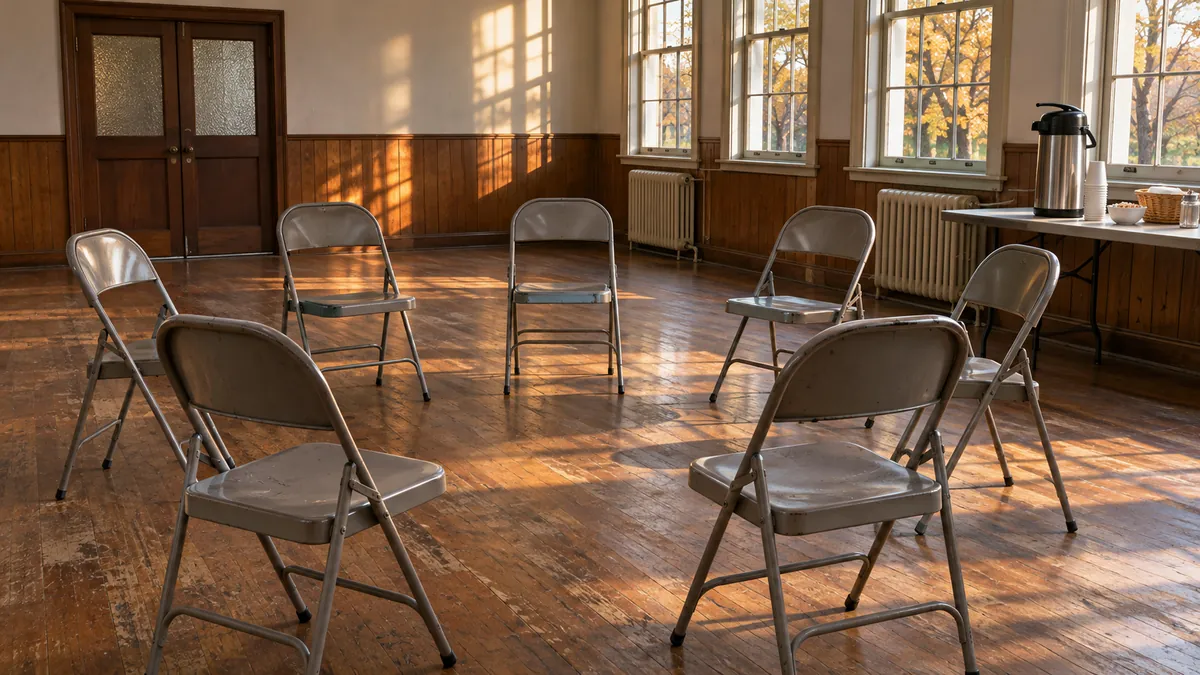
The room before anyone arrives
Every hall of this kind smells a little of floor wax and old coffee. The chairs live in a rack against the wall, hinged and gray, and whoever gets there first pulls them out one at a time, opens them with that flat metal clap and sets them down in a ring. Rows would be easier to arrange. Rows also let people sit behind each other and look at the back of a head. The circle is chosen on purpose: once it is set, nobody can sit out of sight, and everybody can see whoever happens to be speaking.
That arrangement does something to the people who sit in it. In a row, you can drift. In a ring, the talk moves around the room, and your eyes and ears have to move with it. You find yourself tracking who has spoken, who has not yet, and which point from ten minutes ago someone is now circling back to. It is not hard work. It is steady work, and it lasts for an hour or so.
What a ring of chairs asks of you
Strip away the coffee and the agenda and a group conversation is a long sequence of small mental tasks. You hold the gist of what the person on your left said while the person across from you answers it. You wait your turn, which means keeping your own point in mind for a minute or two without letting it fade. You notice that the quiet woman by the window has started to lean forward and probably has something to add. You recall that the man two seats down mentioned his grandson's knee surgery last time, and you ask how it went.
Each of those acts leans on attention and on the short-term holding space we all rely on to keep a thought steady while something else is going on. Researchers who study healthy aging have spent years looking at how social engagement and conversation relate to how sharp people feel later in life. The picture they describe is not a simple cause and effect, and no honest writer should promise that a weekly meeting will change anything in particular. What can be said is plainer: a lively conversation keeps a person busy in exactly the ways a quiet evening alone does not, and many people in their later decades report feeling more awake and more themselves after an hour of it.
There is a social side to this too. Retirement, a move, a spouse who has passed or children who now live in three different states can thin out the number of people who expect to see you on a given Tuesday. A standing gathering, whatever it is about, puts that expectation back. Someone notices if your chair is empty, and that small accountability tends to get people out of the house on nights when the couch would have won.
Names as a daily exercise
Most people past fifty will say the same thing sooner or later: faces stay, names slip. A ring of chairs is a good place to work on that, because the same faces come back week after week and give you repeated chances. A few habits help, and none of them needs any equipment.
Say the name back when you hear it. "Good to meet you, Dolores" does more than "good to meet you." The extra second of saying it aloud gives the name a second pass through the head.
Hang one detail on it. Dolores from the library board, Dolores who drove up from Tucson, Dolores with the red reading glasses. A name with a peg attached is easier to find later than a name floating on its own.
Use it once more before the evening ends. Asking "Dolores, what did you think about the parking question?" is a natural thing to do in a circle, and it is also the third time you have reached for the name that night.
Write it down afterward. That last step belongs to the second reading on these pages, where the notebook comes in.
If you are not part of any group
Plenty of readers will not have a hall to walk into on Thursday. That is common, and it is fixable without joining anything grand. Public libraries in most American towns run reading circles and talks. Houses of worship host coffee hours and committees. Community colleges offer evening classes where the same dozen people meet for eight weeks. Neighborhood associations, garden clubs, volunteer fire auxiliaries, veterans' posts, local history societies and choirs all set out chairs on a regular night. The topic matters much less than the format: the same people, a regular time, a conversation that everyone is expected to follow.
If none of those appeal, the habit scales down. Two neighbors on a porch, a standing lunch with an old colleague, a weekly phone call that runs long enough for a real back and forth. The point is to put yourself regularly into talk where you have to listen, wait and answer, rather than into hours of programming that asks nothing back.
A modest plan for the week
One standing gathering of any kind, on a fixed day, written on the calendar in ink. Arrive five minutes early, because the minutes before a meeting starts are when the easiest conversations happen. Learn one new name each time, using the three steps above. Ask one question about something a person told you the previous week. And on the way home, before the car pulls into the driveway, run through the circle in your head, chair by chair, and see how many of the faces you can put a name to.
That last exercise takes about two minutes. It is also the bridge to the second reading, which picks up exactly where the car stops.
Blank form, to be filled in at a doctor's office
If names, appointments or the thread of a conversation slip more often than they used to, if someone close to you has started to mention it, or if you feel more confused or withdrawn than usual, write it down here and take it to a physician. Changes like these deserve a professional look, and a doctor can check for ordinary, treatable causes that no amount of chair-setting will touch.